La agencia espacial estadounidense (NASA) presentó hoy las fotos de la primera flor que ha crecido en la Estación Espacial Internacional (EEI) como parte de un experimento de dos años para cultivar plantas en el espacio.
Mostrando entradas con la etiqueta #NASA. Mostrar todas las entradas
Mostrando entradas con la etiqueta #NASA. Mostrar todas las entradas
miércoles, 20 de enero de 2016


sábado, 5 de diciembre de 2015
La NASA divulga las imágenes más nítidas jamás vistas de Plutón
La sonda de la NASA New Horizons ha transmitido las imágenes más nítidas jamás vistas de la superficie de Plutón, obtenidas durante una aproximación efectuada el pasado verano.
domingo, 11 de octubre de 2015
VERITAS, la NASA pone la vista en el olvidado Venus
Artículo de Javier Peláez
Durante la última semana hemos estado muy pendientes del anuncio por parte de NASA de la confirmación en Marte de agua salada en la superficie. Todos los medios de comunicación han prestado especial atención a esta noticia y hay que reconocer que posiblemente se nos hayan quedado en el tintero otras que también son interesantes y que tienen como protagonista otro fascinante planeta: Venus.
viernes, 24 de julio de 2015
La NASA descubre un planeta casi gemelo de la Tierra
Vía Antena 3.com
Las observaciones del telescopio espacial Kepler de la NASA han permitido detectar al primer planeta de un tamaño similar al de la Tierra orbitando en la zona habitable de una estrella parecida al Sol.
Las observaciones del telescopio espacial Kepler de la NASA han permitido detectar al primer planeta de un tamaño similar al de la Tierra orbitando en la zona habitable de una estrella parecida al Sol.
miércoles, 15 de julio de 2015
La conquista de Plutón inicia una nueva era en la exploración espacial
Vía El País
La NASA celebra la histórica visita de la sonda 'New Horizons' al planeta enano.
jueves, 7 de mayo de 2015
La NASA capta la tormenta solar más violenta del año
Vía Antena 3.com
 Unos minutos después de la media noche (hora española) del 5 de mayo, el sol lanzaba una potente llamarada que capturaban los instrumentos del Observatorio de Dinámica Solar de la NASA. Los satélites de la agencia estadounidense grababan el momento, en el que los diferentes colores indican las distintas longitudes de ondas de la radiación emitida.
 Unos minutos después de la media noche (hora española) del 5 de mayo, el sol lanzaba una potente llamarada que capturaban los instrumentos del Observatorio de Dinámica Solar de la NASA. Los satélites de la agencia estadounidense grababan el momento, en el que los diferentes colores indican las distintas longitudes de ondas de la radiación emitida.
La intensa explosión ha sido clasificada con el nivel X .7, (la X denota la categoría de mayor potencia en estos eventos) y se producía en la mancha solar denominada Región Activa 2339. El fenómeno supera al anterior, ocurrido el 11 de marzo y clasificado como X 2.2.
viernes, 6 de marzo de 2015
Spacecraft becomes first to orbit mysterious dwarf planet Ceres
By CNN
NASA's tractor-trailer-sized Dawn spacecraft is now in orbit around Ceres, becoming the first probe to orbit a dwarf planet.
The spacecraft was about 38,000 miles (61,000) kilometers from Ceres when it was captured by the dwarf planet's gravity, NASA said Friday.
Ceres was discovered in 1801 (Pluto wasn't found until 1930) and was the first object found in our solar system's main asteroid belt between Mars and Jupiter. It's about 310 million miles from Earth and was initially classified as planet, then later demoted to an asteroid, only to be reclassified again as a dwarf planet.
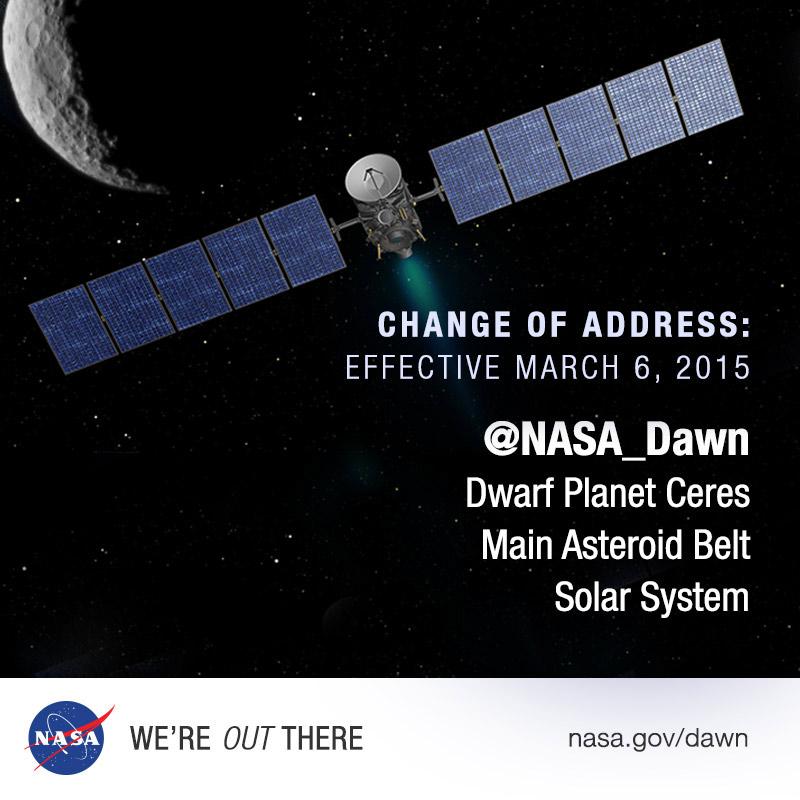
Even before Ceres entered orbit, the early images from Dawn had mission scientists excited.
"Ceres has really surprised us," said Carol Raymond, Dawn's deputy principal investigator. "The first images have produced some really puzzling features."
One of the puzzles -- two bright white spots that showed up in photographs taken by Dawn in February.
"These spots were extremely surprising to the team, and they have been puzzling to the team and to everybody who's seen them."
The spots are in a crater that's 57 miles (92 kilometers) wide. The spot in the center of the crater is about twice as bright as the spot on the side of the crater.
"This extreme brightness was really unexpected," Raymond said. The Dawn team is "really, really excited about this feature because it is unique in the solar system."
Raymond says the brightness is consistent with highly reflective materials such as ice or salts. This might help add more credence to a discovery made in 2014 by the European Space Agency's Herschel infrared space observatory. The telescope detected water vapor around Ceres coming from the same area where the spots are.
"It might be related to that water vapor emission," Raymond said. Herschel's scientists also said their research showed Ceres has an atmosphere. Raymond said her team is keen to confirm that.
Scientists expect to learn more as Dawn is gradually lowered to about 235 miles above the surface of Ceres in December. "The mystery will be solved," she said.
But Ceres seems to have lots of oddities.
"We see many strange features," Raymond said. "We see smooth areas, some areas that are chaotically fractured and we see craters of all sizes."
One of the other things scientists noticed is how round Ceres is. Being round is very important because it is the main characteristic of a planet -- a title that Ceres had, and then lost.
Ceres was demoted to an asteroid because 19th-century astronomers couldn't be sure it was round. But it was bumped up to a dwarf planet when that category was created in 2006.
According to the International Astronomical Union -- the group that came up with the definition -- a dwarf planet is similar to the eight main planets (Mercury, Venus, Earth, Mars, Jupiter, Saturn, Uranus and Neptune) except it has a lot of other stuff orbiting with it around the sun.
The IAU recognizes five dwarf planets: Eris, Pluto, Ceres, Makemake and Haumea. Scientists say there could be many more of these small worlds that haven't been discovered.
Dawn was launched on September 27, 2007, from Cape Canaveral, Florida. Its journey has taken it past Mars and on a short layover at the asteroid Vesta.
On Friday, Dawn will make its closest approach yet to Ceres, flying about 25,000 miles from it, said Robert Mase, project manager for the Dawn mission at NASA's Jet Propulsion Laboratory in Pasadena, California. "That's about 10 times closer than the moon is to the Earth," he said.
But the beautiful images coming in from Dawn will stop for a while.
"We're now on the dark side, so we're going to have a blackout for about the next month until we get back over toward the lit side of the body," he said.
But he says the "floodgates will open" when its main science mission starts in April.
Dawn will stay in orbit around Ceres for years, even after its primary mission ends in June 2016. But at some point, it will run out of hydrazine, the fuel used to guide the spacecraft.
Between now and then, mission managers hope Dawn will help solve the mysteries of Ceres and add to our knowledge of how our solar system formed.
Suscribirse a:
Entradas (Atom)